Who Actually Needs Your Wedding Timeline? More People Than You Think.
At some point during wedding planning, your timeline stops being a document for the two of you.
It becomes a working document for an entire team.
Your photographer needs it.
Your DJ needs it.
Your caterer needs it.
Your florist needs parts of it.
Transportation probably needs parts of it.
Hair and makeup may need it.
The venue needs it.
And your coordinator?
We need to know what everybody is doing.
But here's where things get interesting:
Not everyone needs the same information.
Your photographer does not need three paragraphs about when the catering team is setting salads.
Your caterer probably doesn't need to know exactly when you're putting on your earrings.
And your florist does not need to know what song is playing when the wedding party enters the reception.
Everybody doesn't need to know everything.
But everybody needs to know their part.
There Isn't Really Just One Timeline
When couples think about a wedding timeline, they usually picture something like:
Ceremony: 5:00 PM
Cocktail Hour: 5:30 PM
Reception: 6:30 PM
Dinner: 7:15 PM
Dancing: 8:30 PM
And yes, those things matter.
But underneath that simple version is a whole other wedding.
While you're getting dressed, hair and makeup may be finishing services, personal flowers may be arriving, the photographer may be photographing details, transportation may be preparing for departure and the venue may already be open for vendor load-in.
Before you walk down the aisle, your florist has been there.
Your rentals have been delivered.
Your DJ has completed sound check.
Your photographer has been working.
Catering is preparing.
Your coordinator has probably already answered seventeen questions.
Okay, maybe not seventeen.
But it's early. Give us time. ⏳
The timeline isn't simply a schedule of what the couple is doing.
It's a map of how the entire wedding comes together.
Your Photographer Is Watching the Light
Your photographer is thinking about your wedding differently from almost everyone else.
They need to know when you're getting ready.
When details will be available.
When the bouquet will arrive.
Whether you're doing a first look.
When family photos happen.
How long portraits are expected to take.
When the ceremony begins.
And depending on the time of year, exactly when the sun is going down.
If sunset portraits are planned for 7:12 PM, “somewhere around seven” is not particularly helpful.
Photography has its own rhythm within the larger wedding day.
That information needs to work with everything else.
Because if portraits run longer, something after them may need to move.
And that's where communication comes back in.

Your Caterer Is Watching Service
Catering sees the timeline through an entirely different lens.
They're thinking:
When are guests being seated?
When are introductions happening?
Are there welcome remarks?
When is the first course served?
When are speeches?
When does the entrée need to leave the kitchen?
When is cake being served?
A ten-minute change can matter when food is involved.
That's why we don't casually move speeches twenty minutes without talking to catering.
There may be 150 plates behind those ballroom doors with very strong opinions about our new plan.

Your DJ Is Listening for Cues
Your DJ or band isn't simply waiting for dancing to begin.
They may be responsible for ceremony audio, processional music, introductions, first dances, parent dances, speeches, announcements, cake cutting and the final song of the evening.
They need to know what is happening.
But they also need to know when we're actually ready for it to happen.
A timeline might say introductions are at 6:30.
That does not mean we press play at exactly 6:30 while Grandma is still finding her table and the photographer is in the hallway with the couple.
The timeline gives us the plan.
Communication tells us when the room is ready.

Your Florist Is Thinking About Access
For florists, designers and rental teams, some of the most important times on the timeline happen before a guest ever arrives.
When can they access the venue?
How much installation time do they have?
When does everything need to be finished?
When does photography begin in the space?
Is something moving from the ceremony to the reception?
When can breakdown begin?
When does everything need to be out?
A beautiful installation still needs a realistic window in which to become beautiful.
“Ceremony starts at five” doesn't tell your florist when they can start working.
Access time does.

Transportation Has Its Own Clock
Transportation is one of those pieces that can quietly affect the entire wedding.
When does the wedding party leave the hotel?
How long is the drive?
When should guests board the shuttle?
How many trips are required?
Where exactly is pickup?
When does the final shuttle leave the reception?
If a bus needs to depart at 4:15, that doesn't mean everyone starts looking for their shoes at 4:15.
Departure time and ready-to-leave time are two different things.
Your transportation company needs its information.
Your coordinator needs to know how that information connects to everything happening before and after it.

The Venue Needs to Know What Is Happening in Its Space
Your venue is managing access, rooms, staff, rules, loading areas and often multiple departments.
They may need to know:
When vendors arrive.
When doors open.
When guests arrive.
When ceremony spaces need to be ready.
When room transitions happen.
When catering or bar service begins.
When entertainment ends.
When breakdown starts.
When everyone must be out.
And if your venue only allows vendors into the space two hours before the ceremony?
That changes the conversation.
Because now we need to make sure what we've designed can actually be installed within two hours.
The timeline doesn't exist separately from the venue.
It has to work inside the reality of the venue.
And Then There's Your Coordinator
This is where our version of the timeline gets a little ridiculous.
In the best possible way.
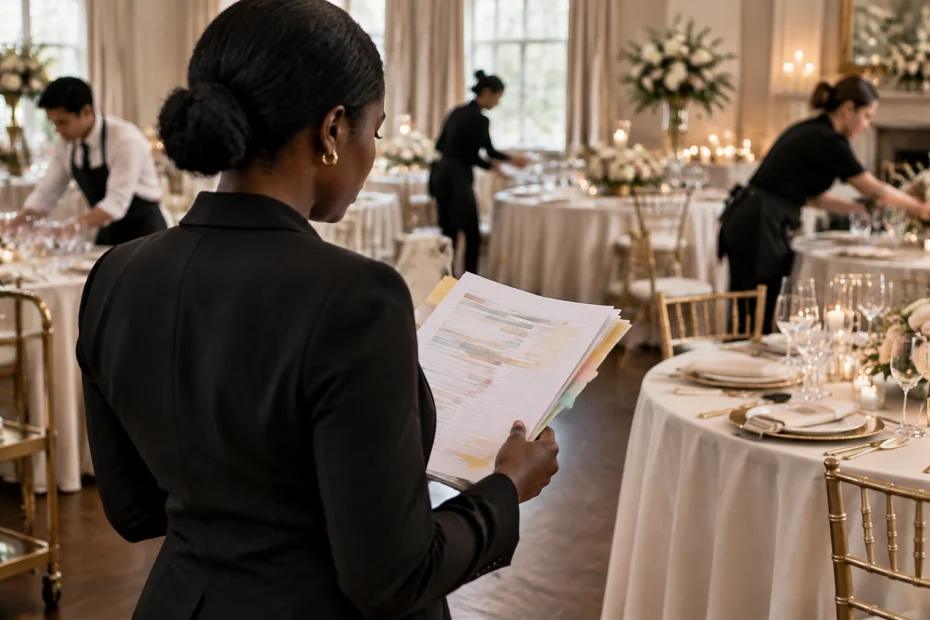
Because while each vendor is primarily watching their own responsibilities, the coordinator is watching the intersections.
I need to know when your photographer expects the bouquet.
And when your florist expects to deliver it.
I need to know when catering wants to begin dinner.
And when the DJ has speeches scheduled.
I need to know when transportation arrives.
And whether the couple will actually be ready to leave.
I need to know when the ceremony space is available.
And whether the florist has enough time to install what we've planned.
I need to know when the photographer wants sunset portraits.
And what will be happening in the reception while the couple is gone.
That's why the coordinator's timeline tends to contain more information than anybody else's.
We're not doing everybody's jobs.
We're making sure everybody's jobs can happen together.

Not Every Vendor Needs a 12-Page Timeline
More information is not always better communication.
Sending every vendor every detail can actually make important information harder to find.
The goal is not:
Here are twelve pages. Good luck.
The goal is:
Here is the information you need to do your job well.
Your vendors should know their arrival time.
Their setup or access window.
The events that affect their responsibilities.
Any cues they need.
Any important transitions.
Their breakdown or departure requirements.
And who they should contact if something changes.
Clear information is useful information.
The Couple Doesn't Need the Same Timeline Either
And while we're here, you don't necessarily need to carry the master vendor timeline around on your wedding day.
Please don't.
You don't need to know that catering is arriving at 2:15.
You don't need to know that the DJ's sound check moved ten minutes.
You don't need to know that the florist is using the service entrance.
You certainly don't need to be answering questions about any of it while someone is doing your hair.
Your version of the day can be much simpler.
Hair and makeup.
Get dressed.
Photos.
Ceremony.
Cocktail hour.
Reception.
Eat something.
Dance.
Have fun.
Get married somewhere in there. Very important. ⚠️
The operational details belong with the people responsible for operating the wedding.
One Plan. The Right Information. The Right People.
A wedding timeline isn't useful because it predicts every minute perfectly.
It is useful because it gives an entire team a shared plan.
And when that plan changes—as plans occasionally do—we know who needs to know.
That's the part couples rarely see.
Your photographer is watching photography.
Your caterer is watching service.
Your DJ is watching cues.
Your florist is watching installation.
Your venue is watching the space.
Transportation is watching the clock.
And your coordinator is watching how all of it connects.
Everyone doesn't need to know everything.
But everyone needs to know their part.
And somebody needs to know how all the parts fit together.
A Very Lovely Wedding