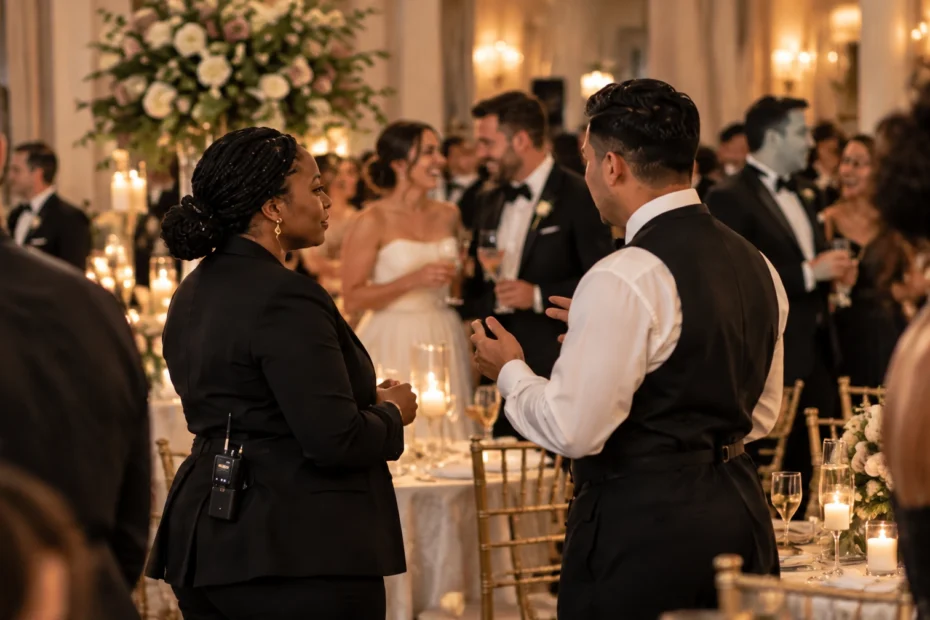
Your Vendors Should Be Talking to Your Coordinator, Not You
There is a very specific kind of wedding-day question that somehow always sounds innocent.
“Where should I put this?”
“Are we ready for introductions?”
“Do you want us to serve dinner now?”
“Has anyone seen the florist?”
“What time is the shuttle leaving?”
All perfectly reasonable questions.
And none of them should be directed at the person currently wearing a wedding dress.
Or a tux.
Or standing five minutes away from walking down the aisle.
Or trying to eat the dinner they spent six months choosing.
On your wedding day, you should not be the information desk.
Your vendors should be talking to your coordinator, not you.
Not because you aren't allowed to know what's happening.
Because you hired someone specifically to know it for you.
Someone Has to Be the Point of Communication
A wedding has a lot of moving parts.
Venue.
Catering.
Photography.
Videography.
Florals.
Entertainment.
Rentals.
Transportation.
Hair and makeup.
Cake.
Lighting.
And depending on the wedding, quite a few more.
Every one of those professionals has questions, timing considerations and information that may affect someone else.
Without a clear point of communication, those questions have to go somewhere.
And if nobody has established where?
They tend to travel toward the couple.
That is exactly what we're trying to prevent.
Your coordinator becomes the central point of communication for the wedding day.
One wedding. One team. One point of communication.
Please Don't Call the Bride
I say this with love.
Please don't call the bride.
Please don't call the other bride.
Please don't call the groom.
Please don't call the person getting married because the delivery driver can't find the loading entrance.
Call me.
If the florist needs access to the ceremony space?
Call me.
If the photographer wants to know whether we're ready for the first look?
Call me.
If transportation has arrived?
Call me.
If the DJ needs to know whether we're ready for introductions?
Look for me.
If catering needs another ten minutes?
Definitely tell me.
This is not about keeping information away from the couple.
It's about deciding which information actually requires the couple's attention.
Most wedding-day logistics don't.

Your Coordinator Is Not Replacing Your Vendors
This distinction matters.
Your coordinator isn't there to tell the photographer how to photograph.
We're not telling the caterer how to run their kitchen.
We're not telling the DJ how to mix music.
And I promise I am not wandering over to your florist saying, “Have you considered moving that rose three inches to the left?”
Everybody has their expertise.
The coordinator's responsibility is different.
We're watching how those areas of expertise connect.
The photographer may need five more minutes.
That information could affect transportation.
Transportation could affect the ceremony start.
The ceremony start could affect cocktail hour.
Cocktail hour could affect dinner service.
Dinner service could affect speeches.
Speeches could affect dancing.
Nobody did anything wrong.
One thing simply moved.
Now someone needs to make sure everyone affected knows.
That's coordination.

Not Every Question Needs to Become Your Question
This is one of the biggest differences between being informed and being interrupted.
You may absolutely want to know if rain means your outdoor ceremony needs to move inside.
You probably need to know if an important family member hasn't arrived and we're about to begin the ceremony.
You should know about decisions that genuinely require your preference, approval or participation.
But you do not need to know that the rental truck is at the wrong loading dock.
You don't need to decide where the DJ should park.
You don't need to answer whether the cake table is ready.
You don't need to tell the photographer where the florist left the boutonnières.
And you definitely don't need four different vendors asking you what time dinner starts when the answer is already on the timeline.
There is a difference between:
“The couple needs to make this decision.”
and
“Someone needs an answer.”
Those are not always the same thing.
Sometimes My Job Is Simply to Say, “I've Got It.”
Wedding days are full of tiny decisions.
Most of them aren't dramatic enough to become stories.
A vendor arrives early.
A table number is missing.
A family member is somewhere they aren't supposed to be yet.
The photographer needs the rings.
Someone moved the card box.
A shuttle is three minutes away.
The cake arrived.
A microphone needs to be moved.
The flower girl has disappeared.
She's usually with snacks.
None of this means the wedding is going badly.
It means a wedding is happening.
And when there is a coordinator managing communication, most of those little things can be handled without ever entering the couple's world.
Sometimes the answer is simply:
“I've got it.”
Then we handle it.

Good Vendors Make This Easier
The best vendor teams understand this quickly.
They don't need to have worked together before.
They don't need to be on the same preferred-vendor list.
They don't need a group friendship bracelet.
They just need to communicate.
If something changes, tell the coordinator.
If you need more time, tell the coordinator.
If you're ready early, tell the coordinator.
If you see something that could affect another vendor, say something.
Good communication isn't about hierarchy.
It's about making sure the person responsible for seeing the whole wedding has the information necessary to do that job.
We are one team.
And Yes, Sometimes I Will Come Ask You
There are decisions I cannot—and should not—make for you.
If weather changes your ceremony options, we're having a conversation.
If someone important is unexpectedly absent, you may need to decide whether we wait.
If a vendor proposes a significant change to something you've approved, I may need your answer.
If something affects your experience, priorities, budget or an important personal decision, I am not going to quietly decide that for you.
Coordination does not mean taking away your voice.
It means protecting you from all the things that don't require it.
The goal isn't for you to know nothing.
The goal is for you to only be brought into the things that actually need you.

Your Family Doesn't Need to Become the Communication Center Either
And while we're redirecting phone calls…
Your maid of honor doesn't need them either.
Neither does your mother.
Or your brother.
Or the friend who happens to be extremely organized and therefore accidentally gets promoted to unpaid assistant every time something happens.
Your people came to your wedding to be your people.
They should be getting dressed with you.
Taking pictures.
Crying during the ceremony.
Eating dinner.
Giving speeches.
Dancing.
Finding the late-night snacks before everyone else does.
They shouldn't be standing in a hallway explaining the loading entrance to a rental driver.
Let them be guests too.

The Best Communication Is Often the Communication You Never Hear
When wedding-day communication is working well, you probably won't notice most of it.
You won't hear the catering captain tell me dinner needs another ten minutes.
You won't hear me tell the DJ we're holding speeches until service is ready.
You won't hear the photographer ask for five extra minutes.
You won't know transportation called to say they're outside.
You'll just experience the result.
Dinner happens.
The music starts.
People move.
The next moment begins.
And you get to stay inside your wedding instead of stepping out of it every time someone needs an answer.
That's the point.
You Have a Wedding to Attend
You spent months planning this day.
When it finally arrives, your job changes.
You are no longer the project manager.
You are no longer the vendor contact.
You are no longer responsible for knowing where everything is, when everyone arrived or whether the next thing is ready.
You're getting married.
So if a vendor has a question?
Call the coordinator.
If something changes?
Tell the coordinator.
If somebody needs to know?
Tell the coordinator.
And if we actually need you?
Don't worry.
We'll find you.
Until then?
You have a wedding to attend.
We'll take it from here.

A Very Lovely Wedding