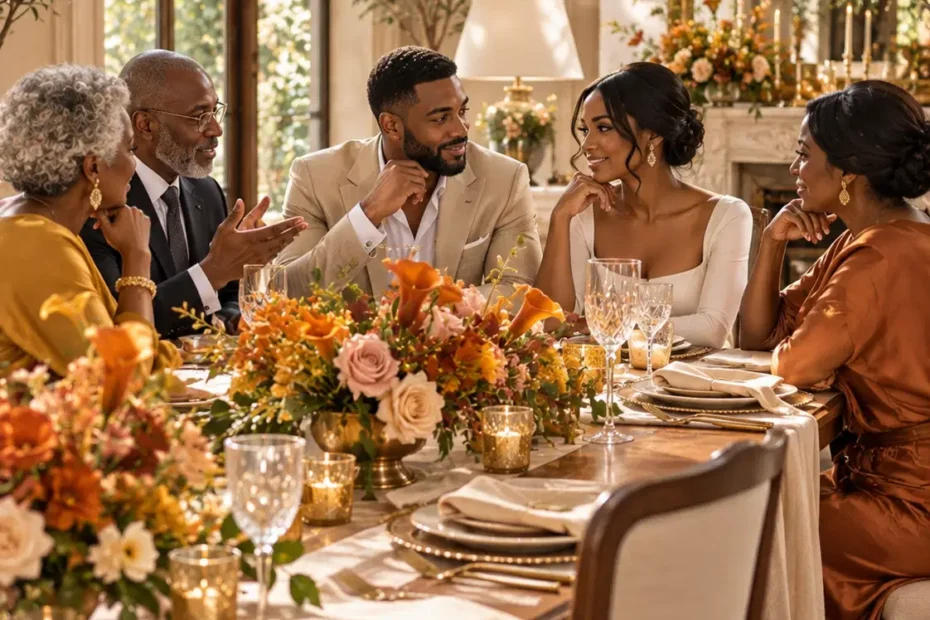
When Your Wedding Becomes a Family Committee
Because loving your family doesn't mean every decision needs a vote.
You got engaged.
There were congratulations, happy tears, excited phone calls, and perhaps a few relatives who immediately started planning a wedding you hadn't even begun imagining.
Suddenly, your mother has a guest list. Your aunt knows a florist. Your cousin has strong opinions about your venue. Someone has already decided which traditions you absolutely must include.
And your wedding?
Well, apparently, it's now a group project.
Here's the thing: most of these people genuinely love you. They're excited. They want to contribute. Some have been imagining this day for years.
But somewhere between “We're so happy for you!” and “You can't possibly do that!”, enthusiasm can begin to feel a lot like authority.
And that's where the conversation gets interesting.
The Difference Between Being Involved and Being in Charge
The Difference Between Being Involved and Being in Charge
Family involvement can be one of the loveliest parts of wedding planning.
A grandmother sharing a meaningful tradition. A parent helping select music that carries family history. A sibling offering to organize a special surprise.
These are the moments that make a celebration feel connected to the people who helped shape your lives.
But involvement and decision-making authority are not the same thing.
There's a difference between a parent saying, “I'd love for you to consider this,” and announcing, “This is what we're doing.”
One is an invitation to discuss.
The other is a decision that somehow happened without the two people getting married.
And no, being related to the couple does not automatically come with voting privileges.
When Financial Help Comes With Expectations
Let's talk about the conversation that often gets uncomfortable.
Money.
Sometimes, family members generously offer to contribute to a wedding. That support can make an enormous difference, and it deserves appreciation.
But what happens when a financial contribution comes with expectations?
Perhaps your parents are covering part of the reception and expect a traditional celebration. Maybe a relative offers to pay for a particular element but wants complete control over its design.
There's nothing inherently wrong with someone having preferences about how their contribution is used.
The problem begins when those expectations are never discussed.
A financial gift and a financial arrangement are not necessarily the same thing.
Before accepting substantial contributions, it's worth having a respectful conversation about what the support means.
Is it a gift without conditions? Is it intended for a specific expense? Does the contributor expect to participate in certain decisions?
Clarity at the beginning can prevent resentment later.
And if the expectations attached to a contribution don't align with the celebration you're planning, you're allowed to reconsider whether accepting it is the right choice.
Gratitude doesn't require surrendering your vision.

The Family Traditions Conversation
The Family Traditions Conversation
Traditions can be beautiful.
They connect generations, preserve cultural identity, and create moments of extraordinary meaning.
But not every tradition will feel equally meaningful to every couple.
Maybe one family expects a religious element while the other doesn't. Perhaps there's a ceremonial custom that has been part of every family wedding for decades, but it doesn't reflect your relationship.
These conversations deserve more than an automatic yes or no.
Start by understanding why a tradition matters.
Is it connected to a loved one? A cultural identity? A family memory? A deeply held belief?
Sometimes, knowing the story behind a tradition changes how you feel about including it.
Other times, you'll discover that the tradition can be honored in a different way.
And sometimes, the most respectful decision is simply to acknowledge its importance without incorporating it into your wedding.
You can value where you come from while making intentional choices about where you're going.

Boundaries Don't Have to Sound Like Arguments
Boundaries Don't Have to Sound Like Arguments
One of the biggest misconceptions about wedding boundaries is that establishing them requires confrontation.
It doesn't.
A boundary can be warm, appreciative, and perfectly clear.
“Thank you for thinking of us. We've decided to go in a different direction.”
“We love that this tradition means so much to you. We're still deciding how it fits into our celebration.”
“We appreciate your suggestions, but we'd like to make this particular decision together.”
Notice what's missing?
An elaborate defense.
You don't have to turn every preference into a courtroom presentation.
You can explain your thinking when a conversation calls for it, but you don't have to keep negotiating a decision simply because someone dislikes the answer.
Kindness and firmness can exist in the same sentence.
Give Your Family a Place in the Celebration, Not Control of It
Here's something I encourage couples to consider: sometimes, what looks like controlling behavior is really a desire to feel included.
That doesn't excuse pressure, but understanding the motivation can help you respond thoughtfully.
Instead of allowing everyone to weigh in on everything, consider inviting family members to participate in specific areas that genuinely matter to them.
Perhaps a parent helps choose a meaningful family song. A grandparent contributes a favorite recipe to the dessert experience. A sibling helps organize a gathering before the wedding.
These contributions can become treasured parts of the celebration.
The important distinction is that participation is intentional.
You're inviting someone into a moment, not handing over the entire planning process.
And yes, some relatives will still have opinions.
They had opinions before you got engaged. We shouldn't expect the wedding to change that. 😉
Present a United Front Without Making Anyone the Villain
When family expectations become difficult, the couple's communication matters.
Before responding to a major request, take time to discuss it privately.
What do you both want? What are you comfortable compromising on? Which decisions matter enough that you'd rather hold your ground?
Once you've reached an agreement, communicate it as a shared decision.
“We've decided…”
“We're planning…”
“This is what feels right for us…”
That language matters.
It avoids positioning one partner as the obstacle and the other as the person who might be persuaded.
It also helps prevent family members from approaching each partner separately in hopes of getting a different answer.
You don't need to create sides.
You need to communicate that you're making decisions together.

Your Wedding Planner Isn't a Family Referee
Your Wedding Planner Isn't a Family Referee
Now, as a wedding planner, I can help couples navigate competing opinions, organize priorities, and communicate decisions clearly.
I can explain why a particular layout won't work, why the timeline needs breathing room, or why adding another major element affects the overall experience.
I can also help translate a couple's vision into a plan that family members understand.
But my role isn't to decide whose family wins.
And it certainly isn't to create conflict where a thoughtful conversation would do.
My responsibility is to support the couple, protect the integrity of their plans, and help everyone move toward a celebration that feels intentional.
Sometimes, that means offering alternatives.
Sometimes, that means providing professional context.
And occasionally, it means reminding everyone that the couple has already made a decision.
Politely, of course.
The People You Love Should Feel Part of the Day
This isn't about shutting family out.
It's about finding the difference between celebrating with the people you love and planning for everyone else's expectations.
Your families have stories, traditions, and hopes. Those things deserve consideration.
So do yours.
The most meaningful weddings don't necessarily include every suggestion or satisfy every preference.
They make room for the people who matter while remaining unmistakably connected to the couple at the center.
Because when the day finally arrives, your family shouldn't feel like they've attended a meeting where every motion passed.
They should feel like they've been invited into something beautiful.
Something personal.
Something that could only belong to the two of you.
And that's a celebration worth planning.
Thoughtfully planned. Beautifully personal.
A Very Lovely Wedding
Show up. Have fun. Do nothing. We'll handle the rest.