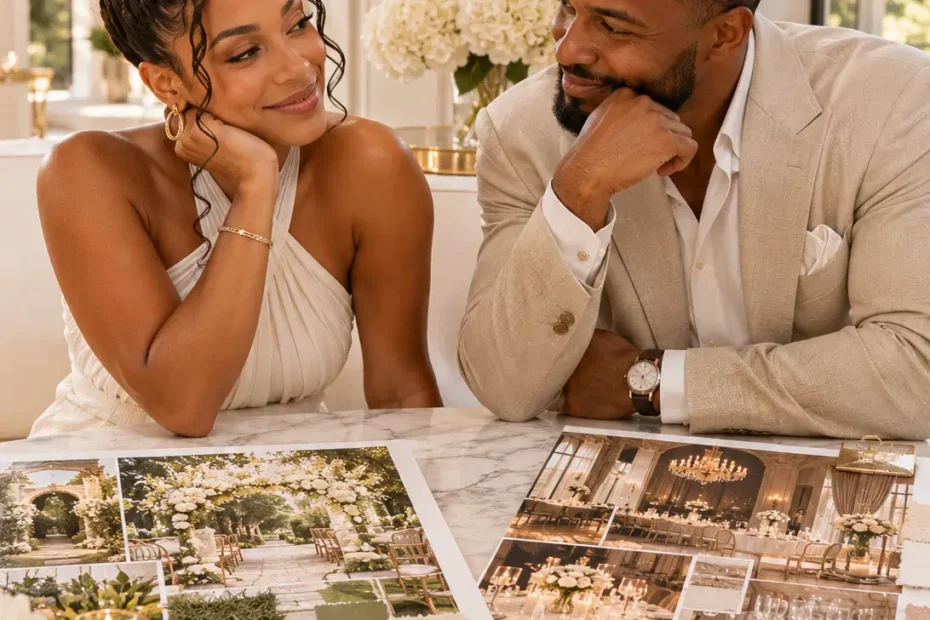
Two People, Two Visions, One Wedding
The Conversations Nobody Warns You About
You fell in love with the same person.
You agreed to spend your lives together.
You said yes to marriage.
And somehow, you still cannot agree on the wedding.
One of you imagines an intimate garden ceremony surrounded by your closest family and friends. The other envisions a grand ballroom, dramatic entrances, and a dance floor that stays full until the very last song.
One wants simplicity. The other wants a statement.
One wants to save. The other wants to celebrate.
And somewhere between Pinterest boards, venue tours, and conversations that start with “I was thinking…” and end with “But that's not what I want,” you begin to wonder how two people who agree on a lifetime together can disagree so much about one day.
Welcome to one of the conversations nobody warns you about.
Here's the good news: You don't have a wedding problem simply because you have different visions.
You have two individuals bringing their personalities, experiences, traditions, and expectations into one shared celebration.
The challenge isn't deciding whose vision wins.
It's discovering what your wedding looks like when both of you belong in it.
The Wedding You Imagined Before You Met
Long before the proposal, you may have already imagined your wedding.
Maybe you pictured yourself walking through a beautiful garden. Maybe you imagined a cathedral ceremony followed by an elegant reception. Perhaps you always wanted a huge celebration because your family has never done anything small.
Or maybe you never thought about weddings at all.
And now you're engaged to someone who has opinions about everything from the guest count to the color of the napkins.
Surprise!
Neither of you arrived at this engagement as a blank canvas.
Your expectations were shaped by the weddings you've attended, your upbringing, your culture, your family traditions, and the experiences that made certain things meaningful to you.
What feels extravagant to one person may feel perfectly normal to the other.
What feels intimate to one may feel uncomfortably small to the other.
Before deciding that your partner's ideas are unreasonable, ask yourself:
What does this particular detail mean to them?
Because sometimes the disagreement isn't really about the detail.
It's about the feeling attached to it.
Stop Debating the Details. Start Discussing the Why.
Let's say one partner wants 150 guests while the other wants 50.
On the surface, that's a disagreement about numbers.
But what if the partner who wants 150 grew up surrounded by extended family and cannot imagine celebrating without them?
And what if the partner who wants 50 values quiet, meaningful conversations and worries that a larger wedding will feel overwhelming?
Now the conversation changes.
Instead of arguing about 50 versus 150, you're discussing connection, family, comfort, and the experience you both want to remember.
The same applies to your venue, ceremony, décor, music, and budget.
Ask each other:
- Why is this important to you?
- What feeling are you hoping to create?
- Is this something you've always imagined, or something you've recently fallen in love with?
- What part of this matters most?
- Where are you comfortable being flexible?
You may discover that you don't actually disagree about the experience you want.
You simply imagined different ways to create it.
And that's a much easier conversation to navigate.

Your Wedding Doesn't Have to Be 50/50 to Be Fair
Your Wedding Doesn't Have to Be 50/50 to Be Fair
Let's address something important.
Compromise doesn't always mean cutting everything down the middle.
If one partner loves flowers and the other doesn't particularly care about floral design, there's no reason to split that decision equally just to prove a point.
Likewise, if music is incredibly important to one partner and the other is happy with almost any playlist, let the music lover take the lead.
The goal isn't to make every decision a negotiation.
The goal is for both people to feel heard, represented, and respected.
A wedding can be balanced without every detail being equally important to both partners.
One person may care deeply about the ceremony.
The other may be passionate about the food and entertainment.
Both contributions matter.
Fairness isn't always about equal control.
Sometimes it's about recognizing what matters most to the person you love.
The Three-Column Exercise
When couples find themselves going in circles, I recommend getting their ideas out of their heads and onto paper.
Not into a shared Pinterest board where one person keeps adding things and the other silently wonders how much all of this is going to cost.
Actual conversations. Actual priorities.
Start with three columns:
Column One: Non-Negotiables
Each of you identifies the elements that genuinely matter most.
These aren't things you simply like. They're the details you would be deeply disappointed to lose.
Maybe it's a religious ceremony, a particular cultural tradition, having your grandparents present, or hiring an incredible live band.
Column Two: Flexible Preferences
These are things you'd love to have but could approach differently.
Perhaps you prefer an outdoor ceremony but would be equally happy with a beautiful indoor space filled with natural light.
Maybe you want an elaborate floral installation but would consider a more intentional design that creates the same impact.
Column Three: Shared Priorities
This is where the magic happens.
Look for the things you both want.
Maybe you both want amazing food, meaningful time with your guests, a beautiful ceremony, and absolutely no stress on the wedding day.
Those shared priorities become the foundation of your celebration.
From there, you can make decisions that support the experience you're building together instead of defending two separate visions.

Different Styles Can Create Something Beautiful
Different Styles Can Create Something Beautiful
One of you loves minimalist elegance.
The other loves glamour.
That doesn't mean your wedding has to look like two unrelated events sharing the same venue.
It means you have an opportunity to create something uniquely yours.
Imagine a clean, sophisticated reception design with dramatic lighting.
Or an intimate garden ceremony followed by a lively, energetic reception.
Perhaps understated florals paired with luxurious textures, statement tableware, and incredible entertainment.
Minimalism doesn't mean empty, and glamour doesn't have to mean excess.
The most beautiful celebrations often come from understanding which elements deserve attention and giving them room to shine.
Your styles don't have to compete. They can complement each other.
That's where intentional design becomes so important.
Rather than adding everything each person likes, consider how those preferences can work together to tell one cohesive story.

When Compromise Starts Feeling Like Sacrifice
When Compromise Starts Feeling Like Sacrifice
There's a difference between being flexible and constantly giving in.
If one person repeatedly says, “Whatever you want,” while quietly feeling disappointed, that's not necessarily agreement.
And if one person is making every decision because the other has stopped participating, that's not partnership either.
Wedding planning shouldn't become a competition over who gets their way.
But it also shouldn't leave one partner feeling like a guest at their own celebration.
Pay attention when a conversation keeps returning to the same disagreement.
Sometimes you need to stop discussing the specific detail and talk about how the planning process is making you feel.
Are you feeling unheard?
Are you worried about the financial commitment?
Do you feel pressured to meet someone else's expectations?
Are you overwhelmed by how many decisions need to be made?
These conversations may not be as exciting as choosing a wedding cake.
But they're far more valuable.
And when you're genuinely stuck, a professional planner can help you explore practical alternatives, understand the trade-offs, and find solutions without taking sides.
Remember Who the Wedding Is Actually For
Family opinions will come.
Friends will have suggestions.
Social media will happily show you 47 different ways to make your wedding more elaborate than you originally intended.
But at the center of all of this are two people making a commitment to each other.
Not two families competing for influence.
Not two Pinterest boards fighting for attention.
And certainly not two people trying to prove whose taste is better.
Just two people.
Building one celebration.
Your wedding should reflect the relationship you've created, not become a battleground between the expectations you brought into it.
You can honor traditions without including every tradition.
You can celebrate your personalities without incorporating every preference.
You can create something extraordinary without doing everything.
The beauty is in deciding what truly belongs.
A Little Advice From Your Wedding Planner
Before you make another major wedding decision, plan an evening that has absolutely nothing to do with booking vendors.
No spreadsheets.
No budget calculations.
No family group chats.
Sit together and talk about what you want to remember when the wedding is over.
Not what you want people to say about the flowers.
Not how impressive you want the reception to look on Instagram.
What do you want to feel?
What moments do you want to share?
What would make you look back years later and say, “That was so us”?
Start there.
Then allow the details to follow.
Because the goal was never to create a wedding where one person wins and the other compromises.
The goal is to create a celebration where both of you recognize yourselves.

Two People. Two Visions. One Love Story.
You won't agree on everything.
And you don't need to.
You're two different people with different experiences, preferences, and perspectives. That's part of what makes your relationship yours.
The wedding planning process gives you an opportunity to practice something you'll continue doing long after the last dance:
Listening.
Understanding.
Making decisions together.
And finding solutions that honor both people.
So when the opinions differ, remember that you're not planning two weddings.
You're planning one.
And the most beautiful thing about that wedding won't be whether you chose a garden or a ballroom.
It will be that somewhere between your vision and theirs, you created ours.
Two people. Two visions. One love story.
A Very Lovely Wedding believes the most meaningful celebrations are the ones that reflect the people at the heart of them. Through intentional planning, thoughtful design, and expert guidance, we help couples create weddings that feel authentically theirs.
Plan Beautifully, Enjoy Fully.