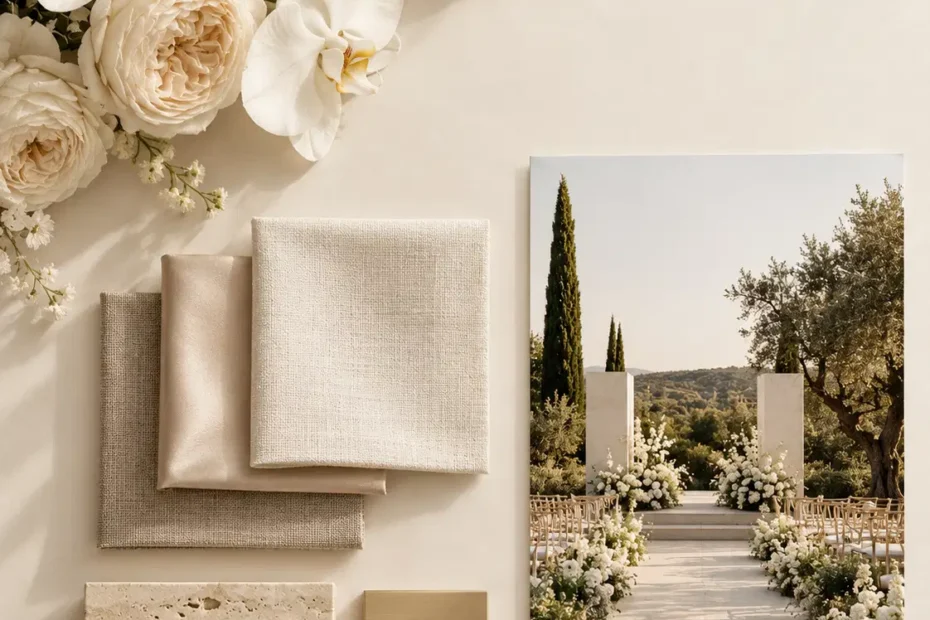
The Quiet Statement: A Wedding Design That Doesn't Need to Shout
Ivory. Champagne. Warm taupe. A little restraint, a lot of intention.
There is a particular kind of beauty that doesn't compete for attention.
It doesn't need an elaborate installation at every turn, a dozen competing textures, or enough flowers to make you wonder whether you've accidentally wandered into a botanical exhibition.
It simply knows what it's doing.
That's the idea behind The Quiet Statement, the first design concept in The Wedding Design Edit by A Very Lovely Wedding.
A celebration built around warm neutrals, thoughtful details, and the understanding that sometimes the most memorable thing in a room is how effortlessly everything belongs together.
The Inspiration: The Quiet Statement
Somewhere along the way, neutral weddings developed a reputation for being predictable.
Ivory became synonymous with safe. Beige became shorthand for boring. And minimalism? Apparently, that meant removing everything interesting until there was nothing left to look at.
We disagree.
A neutral palette can be layered, dimensional, romantic, and wonderfully sophisticated. It simply asks us to pay attention to something beyond color.
The shape of a flower. The way silk catches the light. The contrast between smooth stone and textured linen. The relationship between a beautifully tailored gown and the architecture surrounding it.
When those elements work together, the design doesn't need to shout.
It already has something to say.
The Palette: Not All Neutrals Are Created Equal
For The Quiet Statement, we've chosen four colors that work together without becoming indistinguishable.
Warm Ivory — #F3EDE2
The foundation. Soft, luminous, and welcoming without feeling stark or clinical.
Soft Champagne — #D8C9B5
A gentle layer of warmth that gives the palette its romantic quality.
Muted Gold — #BCA783
An accent rather than an announcement. Think brushed finishes, subtle detailing, and warmth without excessive shine.
Warm Taupe — #8D8073
The grounding element. It creates contrast and prevents the lighter tones from disappearing into one another.
Individually, these colors are understated. Together, they create depth.
And that's the distinction worth understanding: a neutral palette isn't necessarily a monochromatic one.
A beautifully designed neutral wedding relies on variation in tone, texture, finish, and proportion.
Without those differences, everything blends together. With them, even the quietest palette can feel extraordinarily rich.

The Application: Where Texture Does the Talking
Imagine entering a reception where nothing feels excessive, yet nothing feels unfinished.
Ivory linens soften the room. Champagne napkins introduce warmth. Brushed-gold accents catch just enough light to provide definition.
Sculptural orchids and garden roses bring organic movement to the tables, while carefully placed candlelight adds intimacy.
The architecture has room to breathe. The floral arrangements have room to be appreciated. Guests can see one another across the table.
And, perhaps most importantly, the design doesn't require an explanation to feel complete.
This is where minimalism and luxury find common ground.
Luxury isn't determined by how many things occupy a space. It's found in the quality of the choices, the relationship between materials, and the care taken with every detail.
You can have an abundant floral arrangement in a minimalist design. You can introduce beautiful metallic finishes. You can create a room that feels undeniably opulent.
The question isn't whether an element is luxurious.
It's whether it belongs.

The Wedding Party: Part of the Design, Not Separate From It
Wedding design doesn't stop at the reception tables.
What the wedding party wears contributes to the overall visual story, whether we plan for it or not.
For The Quiet Statement, imagine bridesmaids in complementary champagne and taupe gowns, each with a silhouette that suits the individual wearing it.
Not identical. Not competing. Simply cohesive.
The bride's ivory gown becomes a natural focal point, while classic black tuxedos introduce the contrast needed to give the entire composition definition.
Bouquets echo the floral language of the ceremony and reception, creating a connection between fashion and environment.
This doesn't mean every person needs to match the table linens.
Please don't do that.
It means the choices should feel related.
When the wedding party stands together, the colors, fabrics, florals, and surroundings should tell one story rather than four separate ones.

The Design Principle: Restraint Is a Choice, Not a Limitation
There is a difference between a design that feels incomplete and one that feels intentionally restrained.
The first leaves you wondering what's missing.
The second makes you appreciate what's there.
Minimalism requires decisions. Sometimes more decisions than a design that simply continues adding elements until every surface is occupied.
What deserves attention? Where should the eye rest? Which details contribute something meaningful, and which are simply filling space?
Those questions matter.
Because a wedding can be elaborate without being thoughtful, just as it can be simple without being sophisticated.
The goal isn't to use fewer things for the sake of using fewer things.
The goal is to create an experience where every choice earns its place.
Is The Quiet Statement Your Wedding Style?
Perhaps you're drawn to clean architecture, beautiful fabrics, and florals that feel more sculptural than abundant.
Maybe you love a neutral palette but worry it won't feel special enough for your wedding day.
Or perhaps you simply prefer an atmosphere that feels elegant without trying too hard.
The Quiet Statement might be your starting point.
But remember: a design concept is inspiration, not a set of rules.
Your wedding should reflect your taste, your personalities, and the atmosphere you want to create together.
You might love this palette exactly as it is. You might introduce a deeper accent, change the floral direction, or incorporate a meaningful detail that makes it distinctly yours.
That's where good design becomes personal.
And that's where we believe wedding planning gets interesting.
At A Very Lovely Wedding, we believe minimalism isn't the absence of beauty. It's making room for it.
Because the most beautiful wedding isn't necessarily the one with the most.
It's the one where everything feels like it belongs.
Thoughtfully planned. Beautifully personal.
A Very Lovely Wedding
The Wedding Design Edit — Vol. 01
The Quiet Statement is the first of three wedding design concepts exploring different ways to create a celebration with intention, personality, and visual impact.